

Built by enterprise AI engineers

Works alongside your existing SIS & LMS

FERPA Compliant

24/7 Global Support
Built by enterprise AI engineers
FERPA Compliant
Works alongside your existing SIS & LMS
24/7 Global Support
Your institution collected the data. Your systems never learned from it.
US universities and school districts have spent years collecting student data across disconnected systems. The gap between data collected and intelligence acted upon remains the defining failure of institutional technology.
78% Have an AI strategy. Almost none are executing it.
Most institutions completed AI roadmaps in 2023–24. In 2026, the vast majority have not shipped a single AI tool to students or faculty.
EDUCAUSE 2025 Higher Education Technology Report
18 Separate platforms per institution on average
SIS, LMS, advising tools, early-alert systems — all disconnected. AI can’t reason across data it cannot see.
Inside Higher Ed IT Benchmark Survey 2025
89% Say their current vendor cannot deliver real AI
Only GPT wrappers bolted onto existing interfaces. Real institutional intelligence requires training on your data — your students’ actual patterns.
Gartner Higher Education IT Survey 2025
$2.3M Lost annually to preventable student attrition
Average annual tuition revenue lost to preventable dropout at a 12,000-student institution. The interventions exist. The AI to trigger them doesn’t.
NACUBO 2025 Retention Benchmarks

The Challenge Universities and schools Face
Students are already using AI. Institution isn't keeping up.
Students use AI weekly
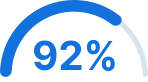
Only 11% of those tools are approved by their institution
Seperate platforms

separate platforms per institution on average

Wasted siloed SIS + LMS

That can't feed an AI — so the data sits, useless
Universities have no AI strategy
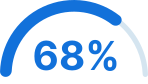
Despite mandating AI literacy in 2026 curriculam
How Justo Works
Your data never leaves your infrastructure · 100% open source · FERPA · COPPA
Your LMS
Courses & activity data

Academic records
Grades & student history
Your infrastructure · your governance
Intelligent SIS
Custom-built for you
LMS × SIS Bridge
Real-time intelligence
AI Learning Assistant
Trained on your content
Institutional Data Platform
Foundation layer · all data governed here · models run inside your environment
What your people receive

Students
24/7 AI answers
Advisors
Early alerts & briefs
Faculty
AI teaching tools
-
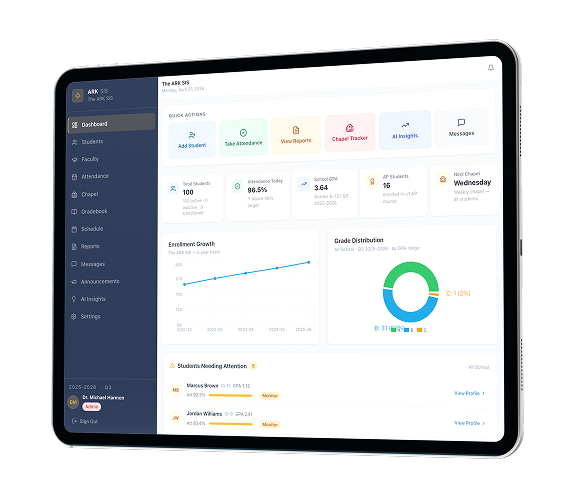
Intelligent SIS
Built from the ground up for your institution. We handle the full data migration from your current system — no operational downtime, no record loss.
Legacy SIS platforms were built to store records. Ours reasons with them. We build your institution's SIS from scratch — customised to your department workflows, your data structure, your student population. It surfaces risk signals and generates insights automatically, without anyone pulling a report.
- Holistic student performance dashboard — grades, attendance, risk in one view
- Automated real-time attendance tracking across all classes
- Direct parent-faculty communication built in
- Targeted school-wide announcements and alerts
- Predictive risk analysis — AI scores each student's withdrawal probability
- Data-driven academic reports and insights for administrators
- Class schedule and curricula planning tools
- Enrollment growth tracking and forecasting
-
AI Learning Assistant
Accuracy-monitored before going live. Semester content refresh in every contract. Human confirmation required on financial aid and compliance responses.
Not a generic AI chatbot. A full learning platform — students get instant AI answers from actual course materials. Faculty get AI-powered teaching tools. Both get a smarter academic experience built on your institution's own content.
- AI chat trained on course materials — instant answers to syllabus, content, and policy questions
- Student dashboard — course materials, assignments, and study guide in one place
- Program overview with AI-enhanced course design tools
- Professor portal — course management, resource creation, AI teaching tools
- Assignment submission management with AI-assisted evaluation
- Separate professor and student access portals
-
LMS × SIS Intelligence Bridge
Works with any major LMS and your existing SIS. No new platform contract. No replacement required.
When a student stops submitting assignments, your SIS should know within hours — not three months later when someone exports a CSV. This bridge learns your institution's specific dropout and failure patterns from your own historical data, not national averages.
- Real-time bidirectional sync — LMS signals flow into SIS risk models within hours
- Automated advisor and counselor alerts with full student context
- Links course engagement to graduation likelihood per student
- ML trained on your institution's dropout history — not national benchmarks
- Works with any major LMS and student records system
- K-12: connects classroom platform to records for absenteeism detection
Meet yourAI agents
They don't wait to be asked.
Currently done manually: Advisor pulls a weekly SIS report, sorts by GPA, cross-checks LMS logs — 45 minutes every Monday. For every student.
Watches LMS engagement, SIS grades, and attendance simultaneously. When risk signals align, it generates the advisor's brief and flags the student — automatically, every day.
Universities · K-12
Currently done manually: Advisor checks each student's transcript against degree requirements before registration. At 380 advisees, most get checked once a year — if they ask.
Audits every student's credit completion against graduation requirements every week. Flags shortfalls the semester they can still be fixed — not after the window has closed.
Universities · K-12
Currently done manually: Counselor reviews daily attendance sheets, identifies students near the 10-day threshold, then calls home — often too late for intervention to change the outcome.
Detects developing absenteeism at Day 3, not Day 10. Sends the counselor a specific alert with the student's full context — not a list of 47 absent students with no priority.
K-12 Schools
Currently done manually: FA staff export a list of incomplete applications weekly, draft individual follow-up emails, and manually track who responded — repeated across hundreds of students each cycle.
Monitors every student's FA application status in real time. Sends personalised deadline reminders and flags missing documents. Staff only get involved when a decision needs judgment.
Universities
Currently done manually: Special education coordinator emails each teacher each semester to confirm accommodations are in place — and hopes everyone replies before the audit.
Continuously monitors whether IEP and 504 accommodations are being delivered across every class. Flags missed implementations to the coordinator before they become compliance violations.
K-12 Schools
Currently done manually: Admissions staff open each application, check document completeness, note what's missing, and send individual follow-up emails — for every applicant, every cycle.
Verifies every submitted document the moment it arrives. Sends personalised follow-up requests for missing items automatically. Staff review only the escalations requiring judgment.
Universities
Your Transformation Journey: Transparent & Proven


Data Audit & SIS Mapping
Catalogue all data sources, assess quality & completeness

Knowledge Architecture Design
RAG indexes, embedding strategy, context windows

Model Training & Fine-tuning
No data leaves your walls — on-prem or private cloud

Agent Configuration (MCPs)
Define what your AI can DO, not just answer

Deploy, Monitor, Iterate
Continuous retraining as your institution evolves
FAQ
How do you ensure FERPA compliance?
What is your approach to legacy system integration?
How long does a typical implementation take?
Do you offer ongoing support and maintenance?
What if we have limited IT staff?
How do you handle data migration?
Can you work with our existing infrastructure and cloud provider?
What makes your AI different from what our current vendor offers?
How do you handle COPPA compliance for K-12 students under 13?
How does pricing work for K-12 districts versus universities?
Request Your AI Assessment
We respond within 2 business days — a working session, not a sales call.